
RFID tag placement is the cheapest variable in an RFID system and the one that decides whether any of the expensive parts work. Move a label 30 millimetres and a tag that failed every read can suddenly read across an aisle.
The reason is not mystical. A passive UHF tag has no battery. It harvests energy from the reader, and its antenna is tuned to a specific electrical environment. Put a conductive surface or a bag of water next to that antenna and you have changed the environment it was tuned for.
This guide covers what metal and liquid actually do to a tag, how RFID tag placement changes on each, and how to qualify a placement so you are not rediscovering the same problem on every new product line.

1. What Metal and Liquid Actually Do to a Tag

Good RFID tag placement starts by separating two effects that get lumped together as “metal blocks RFID”, because they have different fixes.
- Detuning. A conductive surface close behind the antenna shifts the frequency the tag is tuned to. The tag is intact but is now listening slightly off-station, so sensitivity collapses. This is why a label that works on a box fails on a drum.
- Reflection and cancellation. Metal reflects the reader signal. Reflections can arrive out of phase with the direct signal and partially cancel it, producing dead spots that move as the item moves.
- Absorption. Water and water-based liquids absorb energy at UHF frequencies rather than reflecting it. A tag on the wall of a filled container is sitting in front of an energy sink.
- Loading from the item itself. Foils, metallised films, conductive inks and even some dense pastes change tag behaviour without looking metallic.
Our own on-metal product documentation puts it plainly: standard UHF labels typically detune and fail when mounted directly on metal. That is a design limit of a general-purpose label, not a fault, and no amount of clever RFID tag placement rescues it.
2. RFID Tag Placement Rules for Metal Surfaces

There are only two credible RFID tag placement strategies on metal, and mixing them up wastes a lot of money.
Strategy one: use a tag designed for metal
On-metal tags are built with a ground plane or spacer so the metal becomes part of the antenna system instead of ruining it. Our NZM-MR7-6535 on-metal UHF tag is the example we stock: passive, Impinj M700 series silicon, 860 to 960 MHz so one part works across regions, and rated from -40 to 85 degrees Celsius for cold rooms and outdoor yards.
Expect published figures to be ceilings, not promises. Lab handheld testing on that tag shows over five metres on metal at 4 W EIRP; in a region limited to 2 W ERP, and with real mounting geometry, you should plan for less.
Strategy two: get the tag off the metal
If a standard label is commercially necessary, create distance. A foam spacer, a plastic bracket, a flag tag standing proud of the surface, or a non-metallic part of the item all work. A few millimetres of air makes a disproportionate difference.
Whichever route you take, these RFID tag placement habits matter more than the datasheet.
- Mount on a clean, flat area. Curved and ribbed metal changes the effective antenna length again.
- Keep a consistent orientation across the fleet, so a handheld sweep meets every tag the same way.
- Avoid corners, seams and welds, where reflections concentrate.
- Avoid placing tags directly facing each other across a narrow gap.
- Fix the position in writing once it works, then audit that it is still being followed six months later.
3. Tagging Around Liquids Without Losing the Read

Liquid is harder than metal in one specific way: you cannot spacer your way out of absorption. Distance helps, but the fill level moves and the problem changes with it. RFID tag placement around liquid is therefore a geometric problem rather than an electrical one.
- Tag the headspace. Almost every filled container has air at the top. A tag on the shoulder or neck reads far better than one on the belly.
- Tag the cap or closure. Plastic closures put the antenna clear of the liquid entirely and give a repeatable position.
- Use the handle or a hang tag. Anything that stands the antenna away from the fluid mass works.
- Tag the outer packaging instead. If item-level is not required, the carton or tray is a much easier read and often satisfies the actual business need.
- Watch the pallet pattern. Individually readable bottles can become unreadable stacked, because each layer shields the one behind it.
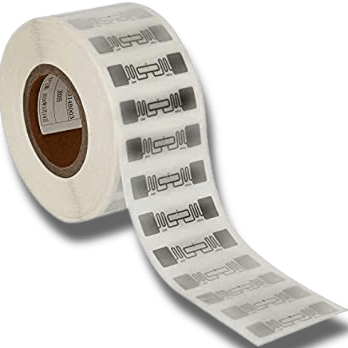
Larger antennas help in absorbent environments because they harvest more energy. That is the practical argument for a bigger inlay such as the NHD-U8-9424 inlay with its 94 by 24 mm antenna, versus a compact 70 by 14 mm inlay intended for small retail items. Both are global 860 to 960 MHz parts on EPC Gen2v2 and ISO/IEC 18000-63, so the choice is about antenna area and item geometry, not compatibility.
4. Placement by Item Type: A Quick Reference

Use this as an RFID tag placement starting point for a trial, not as a final answer. The item, the packaging and the reader all vary.
| Item | Main obstacle | Where to start | Tag type to trial |
|---|---|---|---|
| Carton or corrugated case | None | Flat face, away from the seam | Standard wet inlay label |
| Filled plastic bottle | Absorption | Shoulder, neck or cap | Larger antenna inlay |
| Steel drum or IBC frame | Detuning | Flat panel, consistent side | Purpose-built on-metal tag |
| Metal tool or spare part | Detuning, small surface | Flag tag or recessed mount | Hard on-metal tag |
| Returnable plastic crate | Stacking and shielding | Outer rib, same corner every time | Rigid tag or moulded-in tag |
| Apparel item | None | Hang tag or sewn-in label | Compact retail inlay |
| Cosmetics and small health items | Small size, foils | Base or outer carton | Small high-sensitivity inlay |
| Gas cylinder | Curved metal, outdoor | Collar or shoulder band | On-metal tag rated for weather |
5. What Is Changing in Tag Performance in 2026

RFID tag placement is getting more attention, not less, and for three reasons worth knowing before you specify anything.
Performance is now specified at item level, not tag level
GS1 built a standard around precisely this problem. The Tagged-Item Performance Protocol gives trading partners a common way to state performance requirements and a test protocol that grades the tagged item rather than the bare tag, verifiable independently. Version 1.2 added a family covering smart cabinets and enclosures, largely because pharmaceutical deployments needed it. If you buy on grades rather than part numbers, RFID tag placement stops being a guess.
The air interface itself is being updated
ISO/IEC FDIS 18000-63 is at edition 4 and in its approval phase, due to replace the 2021 edition. GS1’s Gen2v3 adds features that matter in cluttered metal environments: readers can modulate radiated field strength so that fringe tags interfere less, and tag selection can happen at the start of an inventory round so only tags of interest respond.
Harder items are being tagged than before
Item-level tagging started with apparel, which is radio-transparent and forgiving. The growth areas now are cosmetics, food, pharmaceuticals and automotive parts — smaller items, more foil, more liquid, more metal. Vendors are responding with performance layers on top of the standard, such as Impinj’s Gen2X, which the company positions as improving reads on small tags in dense stacks. Verify any such claim on your own items.
6. How to Qualify a Placement Before You Commit

An RFID tag placement trial takes an afternoon and saves a rollout. Run it in this order.
- Map the item. Try four or five candidate positions on a single unit and note which read and which do not.
- Find the worst orientation. Rotate the item through every angle a reader will realistically see. Design for the worst case, not the best.
- Fill it. Test full, half full and empty if the contents change.
- Stack it. Repeat on a full pallet or a full shelf. This is where most placements fail.
- Move it. Read at real conveyor or walking speed, not standing still.
- Write it down. Photograph the winning position and put the photograph in the work instruction.
If several positions work, choose the one that is easiest to apply consistently. A slightly weaker placement that operators always get right beats an optimal placement they get wrong half the time.
Why Work With Navi Label Solutions?
Need Help Choosing a Placement?
Send us a photo of the item, what it is made of, whether it holds liquid, and how it will be stacked or presented to the reader. That is usually enough for us to suggest two or three positions worth trialling.
Tell us the region you operate in as well. Permitted reader power differs, and it changes the read range you can realistically expect from any placement.

Frequently Asked Questions
Why does the same tag work on a box but fail on a metal drum?
Because the metal changes what the antenna is tuned to. The tag is not damaged; it is detuned, so it can no longer harvest enough energy from the reader. Either use a tag built for metal mounting, or put a few millimetres of non-conductive space between the tag and the surface.
How far from liquid does a tag need to be?
There is no single number, because it depends on the container, the liquid and the reader power. The reliable approach is geometric: put the antenna in the headspace, on the closure, or on the outer packaging, and then verify at the fill levels you actually ship.
Can we just increase reader power instead of moving the tag?
Only up to a point, and regulated power limits differ by region. More power also means more stray reads from tags you did not intend to count, which creates a different data problem. Fixing placement is cheaper and more durable than fighting physics with wattage.
Does tag orientation matter as much as position?
Often more. A well-positioned tag presented edge-on to the antenna can read worse than a compromise position presented face-on. Test every orientation the reader will see in practice, and standardise the one you choose.
Should we tag items or cartons?
Start from the read event you actually need rather than from ambition. If you only need to know what left the dock, carton-level tagging is far easier and cheaper. Item-level is worth the extra difficulty when you need shelf accuracy, expiry visibility or authentication. Our overview of RFID tag structure and types covers the trade-offs.